Timber Flooring vs Tiles:
Timber or tiles for your Perth home? We compare summer heat, winter comfort, cost, pets, noise, cleaning and resale to help you choose the right floor.
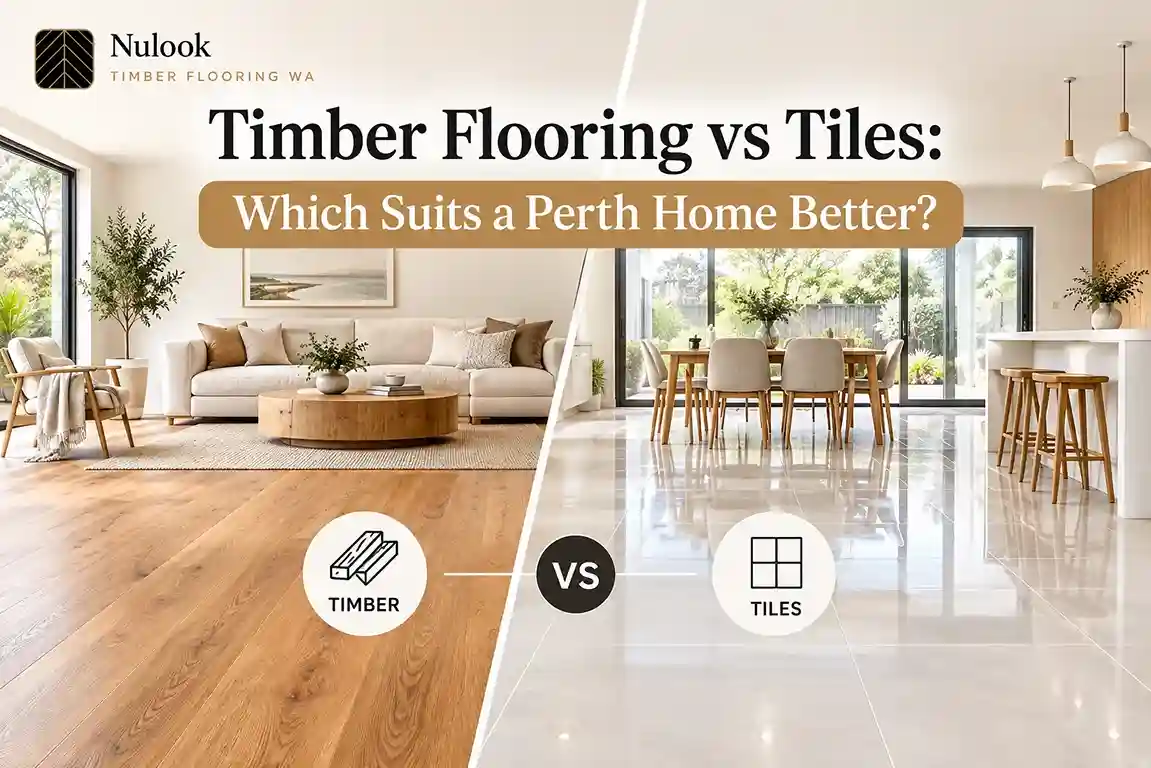
Timber Flooring vs Tiles: Which Suits a Perth Home Better?
Quick answer: Tiles stay cooler in a Perth summer and suit wet areas. Timber is warmer and quieter, it's softer underfoot and it usually adds more appeal when you sell. For most Perth homes, the best result is both: tiles in bathrooms, laundries and alfresco areas, and timber through the living areas and bedrooms.
Walk through a Perth home open and you'll hear the same debate in every second kitchen. "Tiles are cooler." "Timber's warmer." "Tiles last forever." "Timber's nicer to live on." They're all partly right.
The timber flooring vs tiles question has a Perth answer that's different from what you'll read in Melbourne or Brisbane articles. Our summers are long, hot and dry. Most houses are double brick on a concrete slab. And lots of us live close enough to the coast to bring beach sand home every weekend. Here's how the two floors compare under those conditions.
Timber vs Tiles at a Glance
| Timber (engineered or solid) | Porcelain / ceramic tiles | |
|---|---|---|
| Feel in summer | Neutral, not cold | Cool underfoot |
| Feel in winter | Warm | Cold without rugs or heating |
| Noise | Quiet, softer sound | Hard, echoey in open-plan spaces |
| Water | Water-resistant surface only | Waterproof surface |
| Comfort standing | Slight give, easier on legs | Very hard |
| Dropped glass | Might survive | Almost always breaks |
| Scratches | Can scratch; can be sanded | Very scratch resistant; can chip or crack |
| Cleaning | Dry mop, damp mop occasionally | Mop; grout needs regular attention |
| Perth installed price (2026) | Engineered about $94–$210/m² | Tiles about $84–$210/m² |
| Resale | Strong buyer appeal | Neutral; expected in wet areas |
Prices from the What's the Damage Perth flooring cost table.
Heat: Are Tiles Really Cooler in a Perth Summer?
Yes, and it's not in your head. Tiles laid directly on a slab are tied to the concrete and the ground underneath. The Australian Government's Your Home guide on thermal mass explains that a slab in contact with the earth can draw heat away in summer, so tiled surfaces feel cool to bare feet.
Timber works as a light insulating layer over that slab. It won't feel cold in February, but it won't feel icy cool either. The room air temperature is roughly the same. What changes is how the floor feels when you touch it.
That same guide makes a point that matters in winter too: covering a slab with timber or carpet reduces how much winter sun it can soak up and release at night. If you have a north-facing living room designed around passive solar heating, keeping tiles or polished concrete in that sun patch makes sense.
Most Perth homes aren't designed that carefully, though. And most people run the air-conditioner on the hottest days regardless of what's on the floor.
Winter: The Case for Timber
Perth winters are short but damp, and a tiled open-plan room on a cold July morning can feel like a fridge. Timber is warmer to walk on and takes the chill off a room. You notice it most first thing in the morning and in bedrooms.
That's why so many Perth families end up with tiles downstairs and carpet upstairs. They want cool in summer and warm in winter, but it's a messy mix of floor types. Timber through the living areas and bedrooms gets you a single, continuous floor that's comfortable all year.
Noise and Comfort
This one often decides it for families.
Tiles are hard. Voices, TV sound and chair legs bounce off them, and a big open-plan tiled area can feel echoey. Standing at the kitchen bench for an hour on tiles is tiring on your knees and back.
Timber absorbs a bit more sound and has a small amount of give. Glued directly to the slab, engineered timber feels solid and quiet. In a double-storey home, add an acoustic underlay upstairs and you'll hear a lot less from the kids' bedrooms. The ATFA has a useful note on installing over acoustic underlays if you're in an apartment with strata sound rules.
Water and Wet Areas
Tiles win this one outright. Bathrooms, ensuites, laundries and alfresco areas should be tiled (or waterproof). The surface is waterproof and the waterproofing membrane underneath is built into the tiling system.
Timber in a kitchen is fine. Timber floors have been going into Australian kitchens for decades. Wipe up spills quickly, use a mat at the sink and dishwasher, and you'll be OK. Timber doesn't belong in a bathroom or laundry.
If you want a timber look in wet areas, hybrid flooring is the in-between. It has a waterproof core, though water can still get under the joints if it sits. Our engineered vs hybrid flooring comparison explains where hybrid makes sense.
Pets, Kids and Beach Sand
Here's something people don't expect. Tiles are harder on your belongings than timber is on your pets.
Tiles resist scratches very well. Big dogs won't mark them. But drop a glass, a plate or a phone and it's gone. Drop a heavy pan and you might crack a tile, and matching a 10-year-old tile is close to impossible.
Timber will scratch. A large dog running through the house will leave marks in the coating over time. But a matte finish and a light-coloured species like Blackbutt hide most of that. When it does wear, timber can be sanded and recoated to look new. You can't do that with tiles. Our Blackbutt timber flooring guide covers hardness and scratch resistance in more detail.
Sand is the real enemy for both. On tiles, it grinds into grout lines. On timber, it acts like sandpaper under shoes. Good doormats at every outside door fix most of it.
Coastal and Hills Homes
Where you live in Perth changes the answer a little.
Close to the coast, from Cottesloe up to Yanchep or down to Rockingham, sand and salty air are the everyday challenges. Tiles don't mind salt, but grout collects grit. Timber handles coastal air fine indoors. The sand is what wears the coating, so a matte finish and serious doormats matter more here than anywhere.
In the Hills, winters are colder and some blocks are rated for bushfire. Timber's warmth is a bigger plus up there. If you're building new, check your BAL rating. It mostly affects external materials, but it's worth knowing which species are rated. Blackbutt, for example, is suitable up to BAL-29.
Allergies and Indoor Air
Both timber and tiles are hard floors, so both are far better than carpet for dust-mite and pet-hair allergies. Nothing sinks into the surface, and a vacuum or mop picks it all up.
The one weak spot with tiles is grout. In damp areas it can hold mould if it isn't sealed and cleaned. With timber, the thing to check is the finish. Most modern water-based coatings are low in VOCs (volatile organic compounds), so they're a sensible choice if anyone in the house is sensitive to smells.
Cleaning and Maintenance
Timber: sweep or vacuum, then a lightly damp microfibre mop with a pH-neutral timber cleaner. No steam mops. A recoat every few years in busy areas.
Tiles: easy to mop, but grout is the ongoing job. Light grout in a kitchen will darken, and it needs scrubbing and sealing to stay looking fresh. Large-format tiles have fewer grout lines, which helps.
Neither is really "low maintenance". They just need different kinds of care.
Cost: Timber vs Tiles in Perth
On installed price, they overlap more than people think. Perth floor tiles typically run about $84–$210 per m² installed, with a typical job around $135. Engineered timber runs about $94–$210 per m², typically around $145.
The bigger cost differences come from:
- Removal. Taking up old tiles costs $35–$75 per m², and the slab usually needs grinding after. Lifting carpet is $10–$15 per m².
- Prep. Both need a flat slab. Tiles need a waterproof membrane in wet areas.
- Time. Tiling involves setting, grouting and curing. Pre-finished timber can be walked on the same day or next day.
Our Perth timber flooring cost guide has the full breakdown, including a worked example of replacing tiles with timber.
Which Is Better for Resale?
In Perth, timber floors are one of the features buyers ask about. Agents list them near the top of the ad. Tiles in living areas don't put buyers off, but they're rarely a selling point, and dated tiles (think 1990s cream with beige grout) are often the first thing a buyer plans to rip out.
Tiles in bathrooms and laundries, on the other hand, are expected. No buyer wants timber in the ensuite.
Can You Lay Timber Over Tiles?
Sometimes. A floating floor or hybrid can go over existing tiles if they're flat, firmly stuck down and in good condition. It saves removal cost and time.
But there are catches. You lose 10–20 mm of height at doorways, which can mean trimming doors and creating trip points at thresholds. Hollow or drummy tiles underneath will cause problems later. And glue-down engineered timber, which is our preferred method in most Perth homes, usually needs the tiles removed and the slab ground back to bare concrete.
We'll check this on the measure, and our guide to timber flooring over concrete explains the slab prep.
Replacing Tiles with Timber: Engineered or Solid?
If you're pulling up tiles to go to timber, engineered is usually the easier path on a Perth slab. It glues straight down to the ground concrete, sits at a similar height to the old tiles, and handles the dry summers without much movement. See our engineered timber flooring range.
Solid timber flooring is the premium option and can be sanded many more times. On a slab it's usually glued direct or laid over a plywood layer, which adds height. That can be a problem where it meets tiled wet areas that are staying.
Our Recommendation for Perth Homes
Choose tiles for:
- Bathrooms, ensuites, laundries and powder rooms
- Alfresco and outdoor areas
- A north-facing living area designed for passive solar heating
Choose timber for:
- Living rooms, family rooms and dining areas
- Bedrooms and hallways
- Kitchens (with a bit of care at the sink)
- Anywhere you want warmth, quiet and resale appeal
Mixing the two works well if the transition is planned. Line the change up with a doorway or a natural break in the room, choose a timber colour that works with the tile, and use a slim, flush transition strip.
Talk It Through On Site
The right floor for your home depends on which way it faces, who lives in it and how you use each room. Nulook Timber Flooring offers a free on-site measure anywhere in Perth. We'll look at your slab, your light and your layout, and give you a fixed written quote. Browse our project gallery, then book your free measure or call 0405 821 884.
Frequently Asked Questions
Are tiles or timber floors better for Perth's climate?
Tiles feel cooler underfoot in Perth's hot summers, while timber is warmer and more comfortable in winter. Most Perth homes do best with tiles in wet areas and timber in living areas and bedrooms.
Are tiles cooler than timber in summer?
Yes. Tiles laid on a concrete slab draw heat into the slab and ground, so they feel cool to bare feet. Timber feels neutral rather than cold. The air temperature in the room is about the same either way.
Is timber flooring more expensive than tiles in Perth?
Not by much. In 2026, installed tiles in Perth typically cost about $84 to $210 per square metre, and engineered timber about $94 to $210. Removal and slab preparation often make a bigger difference than the flooring itself.
Which is better with dogs, timber or tiles?
Tiles resist scratching better, but they're hard, slippery when wet, and cold for older dogs. Timber can scratch, but a matte finish hides marks and it can be sanded. Many dog owners find a light, matte timber floor a good balance.
Can you put timber flooring in a kitchen?
Yes. Timber flooring is common in Australian kitchens. Wipe up spills quickly and use mats at the sink and dishwasher. Avoid timber in bathrooms and laundries, where standing water is more likely.
Can you lay timber flooring over existing tiles?
Floating floors and hybrid can sometimes go over tiles that are flat and firmly stuck down. Glue-down engineered timber usually needs the tiles removed. Laying over tiles raises the floor height, which can affect doors and thresholds.
Are timber floors noisier than tiles?
No, timber is generally quieter. Tiles reflect sound and can make open-plan rooms echo. Engineered timber glued to a slab feels solid and absorbs more sound. Upstairs, an acoustic underlay cuts noise further.
Which adds more value to a home, timber or tiles?
Timber floors in living areas usually have stronger buyer appeal in Perth and are often highlighted in property listings. Tiles are expected in bathrooms and laundries but are rarely a selling point in living areas.
Which is easier to clean, timber or tiles?
Tiles are easy to mop, but grout lines need regular scrubbing and sealing. Timber needs sweeping and a lightly damp mop with a timber cleaner, plus an occasional recoat. Both are easy with the right routine.
Should I mix timber and tiles in an open-plan home?
Yes, if it's planned well. Use tiles in the kitchen or wet areas and timber in living spaces, and put the change at a natural break such as a doorway or island bench, with a flush transition strip.