Engineered vs Hybrid Flooring: Which Is Right for Your Perth Home?
Engineered timber or hybrid? A Perth installer compares cost, water resistance, feel, lifespan and resale, with real 2026 price ranges. Free on-site measure.
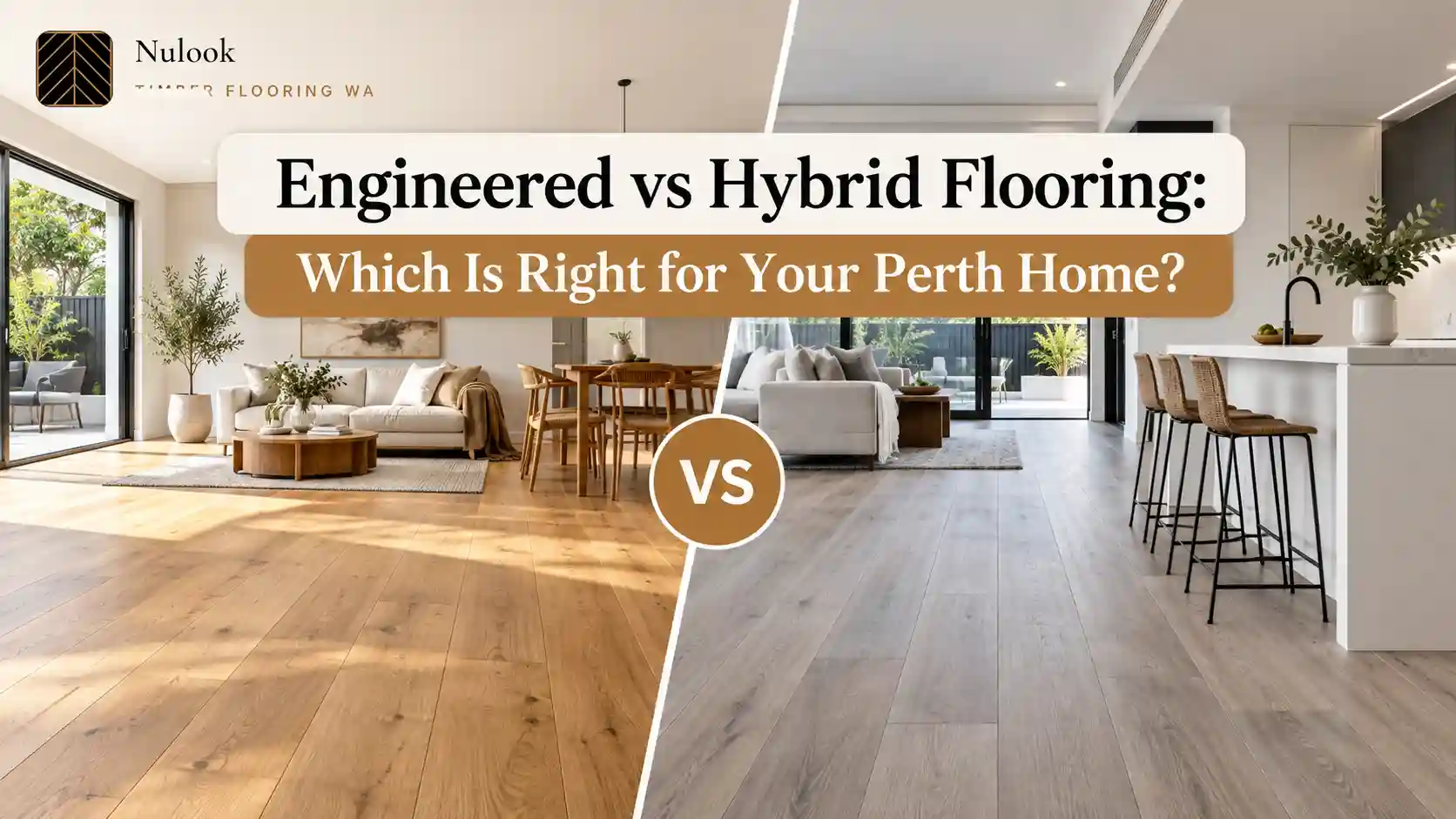
Engineered vs Hybrid Flooring: Which Is Right for Your Perth Home?
Quick answer: Engineered timber is real hardwood on a layered core. It feels warmer, can be sanded back, and adds more resale value. Hybrid is a waterproof rigid-core plank with a printed timber look. It costs less and shrugs off spills and pets. In Perth, engineered usually wins in living areas and hybrid wins in wet, busy or rental spaces.
That's the short version. The longer one depends on how you live, what's under your floor now, and how long you plan to stay in the house.
We get asked the engineered vs hybrid flooring question on nearly every quote at Nulook Timber Flooring. People have usually read five websites by then, and each one has told them something different. So here's how we explain it on site, with actual numbers.
Engineered vs Hybrid Flooring at a Glance
| Engineered timber | Hybrid flooring | |
|---|---|---|
| What it is | Real hardwood wear layer (usually 2–6 mm) bonded to a multi-ply timber core | Rigid core (usually SPC stone-plastic composite) with a printed décor layer and clear wear layer |
| Typical thickness | 14–21 mm | 6.5–9 mm including attached underlay |
| Water | Water-resistant surface, but standing water will damage it | Core is waterproof |
| Can it be sanded? | Yes, often 1–3 times depending on wear layer | No |
| Feel underfoot | Warm, solid, natural | Firmer and cooler, a little "clicky" if poorly laid |
| Perth installed price (2026) | Roughly $94–$210 per m², typical around $145 | Roughly $58–$125 per m², typical around $84 |
| Lifespan | 25–40+ years with a resand | 15–25 years, depending on wear layer |
| Resale appeal | High. Buyers see "real timber" | Good, but reads as a mid-range finish |
Price ranges come from the published Perth flooring cost table on What's the Damage. Your own job will depend on the floor you pick and how much prep the subfloor needs. Our Perth timber flooring cost guide breaks the extras down.
What Is Engineered Timber Flooring?
Picture a sandwich. On top is a slice of real hardwood, say Blackbutt or European oak. Under it sit cross-laid layers of plywood or softwood, glued so the grain runs in different directions. That cross-lay is the whole point. Solid timber moves a lot when humidity changes. Engineered timber moves far less, because each layer is fighting the layers around it.
Why does that matter here? Perth's summers are hot and dry, and winters are cooler and damper. Timber responds to both. The WoodSolutions Timber Flooring design guide says an 80 mm solid board shrinks or swells by about 0.25 mm for every 1% change in moisture content. Across a whole room that adds up. An engineered board with a stable core gives you the real hardwood look with far less of that seasonal gapping.
The wear layer is the number to ask about. A 2 mm top layer might take one light sand in its life. A 4–6 mm layer can be sanded two or three times, which is how an engineered floor ends up outliving the kitchen it was laid next to.
We lay a lot of engineered timber flooring in Perth homes, mostly glued directly to the concrete slab. Most Perth houses are double brick on a slab, and a glue-down engineered floor sounds and feels close to solid timber.
What Is Hybrid Flooring?
Hybrid is a newer product, and it's often misunderstood. It isn't timber at all. The core is usually SPC (stone-plastic composite): limestone powder and PVC pressed into a rigid board. On top is a photographic print of timber grain, and above that a clear wear layer, normally 0.3–0.55 mm thick. Most boards come with an acoustic underlay already attached.
The boards click together and float over the subfloor. Nothing is glued down. That makes installation fast, and it's a big part of why hybrid costs less. Our hybrid flooring installation in Perth service is often done in a day or two for an average home, and you can walk on it straight away.
One thing most suppliers don't mention: SPC contains crystalline silica, so cutting it makes fine dust. Safe Work Australia sets the exposure limit at 0.05 mg/m³, and installers should be cutting with dust control and wearing proper respiratory gear. If your installer is dry-cutting in your lounge with no mask, ask them to stop.
Is Hybrid Flooring Waterproof?
Mostly, yes. The core won't swell if a dog bowl tips over or the kids track in pool water. That's the big selling point.
But "waterproof flooring" isn't the same as a "waterproof room". Water can still get through the joints and pool underneath if it's left sitting, and a burst hose under the sink will still cause damage to what's below. So hybrid is excellent in laundries, kitchens and entries. It isn't a replacement for proper waterproofing in a bathroom.
Engineered timber is water-resistant on the surface thanks to its coating. Wipe up spills within a few minutes and you'll be fine. Leave a leaking pot plant on it for a week and you'll have a stain and possibly a cupped board.
How They Compare in a Perth Home
Heat and sunlight
This one surprises people. Hybrid planks have a PVC-based core, and PVC expands with heat. A big west-facing sliding door in February can push the surface temperature of a floor well past the air temperature. Many hybrid warranties list maximum temperatures and call for window coverings on large areas of glass that get direct sun.
Engineered timber handles heat better, but UV will still change its colour over time. Blackbutt gets a bit warmer in tone and oak goes golden. Rugs moved around now and then keep it even.
If your living room gets hammered by afternoon sun, tell your installer. It changes the advice.
Pets and kids
Hybrid wins on scratch resistance for most day-to-day wear. A good wear layer handles claws, toy trucks and dining chairs well. Engineered timber will mark (all real timber does), but the marks tend to blend in over time, and you can sand them out later. You can't sand a hybrid floor. Once the print is worn through, that board has to be replaced.
Feel and sound
Stand on both in a showroom, in socks. Engineered timber glued to a slab is quiet and solid. Hybrid is firmer and slightly hollow if the subfloor wasn't flattened properly. That hollow sound is almost always an installation problem, not a product fault. Concrete should be ground and levelled first, which is why our process includes grinding and self-levelling before any board goes down.
Looks
Up close, real timber has depth. The grain changes board to board, and light plays across it differently at different times of day. Good hybrid prints are convincing from a standing height, but you'll often see the same pattern repeat every few boards. Some people don't care. Others notice it every time they walk in.
Cost: What You Actually Pay in Perth
On price per square metre, hybrid is clearly cheaper. The installed range for hybrid in Perth runs from about $58 to $125 per m², with a typical job around $84. Engineered timber runs from about $94 to $210 per m², typically around $145.
For a 70 m² open-plan area, that's roughly $5,900 for a mid-range hybrid versus $10,150 for a mid-range engineered floor, before prep. The gap is real.
Prep costs are the same for both products, though, and they're often where quotes go wrong. Removing old tiles, grinding the slab and self-levelling can add a big chunk to any job. We give a free on-site measure with a moisture check and a fixed written quote that lists materials, prep and labour separately, so you can compare products on a fair basis.
Then think about how long you'll own it. An engineered floor can be sanded and recoated in 15 years and look new again. A hybrid floor at 15 years usually needs replacing. If you're staying long-term, the gap narrows a lot.
Installation Time and Disruption
Hybrid is quicker to lay. Because the boards float and click together, a crew can often finish a 60–80 m² area in one or two days once the slab is ready. There's no glue to cure, so furniture can go back the same afternoon.
Engineered timber glued to a slab takes a little longer. The adhesive needs time to grab, and the edges, stair nosings and trims take careful work. For the same area, allow two to three days of laying. Pre-finished boards arrive already coated, so there's no sanding or polishing on site and no drying time for coats. You can walk on it carefully the next day.
For both products, the slow part is usually what happens before the first board goes down. Lifting old tiles, scraping glue, grinding high spots and pouring self-levelling compound can add one to three days. Skipping that step is how you end up with hollow spots, squeaks and boards that won't stay locked together. It's also where a cheap quote often cuts corners.
Staircases add time too. If you want matching treads and nosings, have a look at our timber staircases work before you decide on a product. Engineered timber stair nosings match the floor exactly. Hybrid nosings are made to match, but they're a separate moulded piece.
Which Adds More Value When You Sell?
Real timber. Agents in Perth consistently list "timber floors" as a feature, and buyers walking through a home can tell the difference. Hybrid won't hurt a sale, and it's far better than tired carpet. But engineered or solid timber flooring is the one that shows up in the listing photos and the ad copy.
For an investment property, the maths flips. Tenants are hard on floors, and hybrid's waterproof core and quick board replacement make it the practical pick.
Our Honest Recommendation
Choose engineered timber if:
- You're staying in the home five years or more
- You want real timber for resale
- The area is a living, dining or bedroom space
- You like the idea of sanding it back one day instead of replacing it
Choose hybrid if:
- You have big dogs, young kids or a busy household and want low maintenance
- The area is a kitchen, laundry or entry that gets wet regularly
- It's a rental or a short-term hold
- Budget is the deciding factor
And plenty of Perth homes do both. Hybrid in the laundry and kitchen, engineered through the living areas and bedrooms, with a neat transition strip between them. It's a sensible split, and it's one we install often.
Still torn? Have a look at our Blackbutt timber flooring guide if you're leaning towards a native look, or read up on installing timber flooring over concrete if you're on a slab.
See Both in Your Own Home
Samples look different in your light, on your slab, next to your cabinetry. Nulook Timber Flooring brings both engineered and hybrid samples to the free on-site measure, checks your slab for moisture, and gives you a fixed written quote for each option so you can compare them properly. Book your free measure and quote, or call 0405 821 884.
Frequently Asked Questions
What is the main difference between engineered and hybrid flooring?
Engineered flooring has a real hardwood top layer bonded to a timber core, so it's genuine timber. Hybrid flooring has a rigid SPC core made from limestone and PVC, with a printed timber image on top. Engineered can be sanded; hybrid can't.
Which is better for a Perth home, engineered timber or hybrid?
For living areas in a home you plan to keep, engineered timber usually suits Perth better because it's stable, feels warmer and adds resale value. For kitchens, laundries, rentals and homes with big dogs, hybrid is often the more practical choice.
Is hybrid flooring cheaper than engineered timber in Perth?
Yes. Installed hybrid in Perth typically costs around $58 to $125 per square metre, while engineered timber typically runs from about $94 to $210 per square metre. Subfloor preparation costs are similar for both products.
Is hybrid flooring 100% waterproof?
The core of hybrid flooring is waterproof and won't swell from spills. Water can still seep through the joints if it's left standing, so it isn't a substitute for proper waterproofing in bathrooms or wet areas.
Can engineered timber flooring get wet?
Engineered timber handles everyday spills if you wipe them up quickly. Standing water, leaks or flooding can stain the timber and cause boards to cup, so avoid it in laundries and bathrooms.
Can you sand engineered timber flooring?
Yes. Most engineered boards with a wear layer of 3 mm or more can be sanded and recoated one to three times over their life. Hybrid flooring can't be sanded because the timber look is a printed layer.
Does hybrid flooring look fake?
Good-quality hybrid looks convincing from standing height. Up close, you may notice repeating grain patterns and a slightly flatter look than real timber. Seeing samples in your own light is the best way to judge.
Does hybrid flooring expand in the heat?
Hybrid has a PVC-based core, so it can expand in strong direct sun. In Perth homes with large west-facing windows, use blinds or curtains and check the manufacturer's temperature limits before choosing hybrid for that room.
Which flooring lasts longer, engineered or hybrid?
A good engineered floor can last 25 to 40 years or more because it can be sanded and recoated. Hybrid typically lasts 15 to 25 years, depending on the thickness of its wear layer and how heavily the floor is used.
Can I have hybrid in the kitchen and engineered timber in the living room?
Yes, and it's a common choice in Perth homes. Hybrid handles spills in the kitchen and laundry, while engineered timber gives living areas a real timber finish. A matching colour and a neat transition strip help the two areas flow.