A Perth Homeowner's Guide to Blackbutt Timber Flooring
Is Blackbutt good for flooring? Hardness, colour, cost per m², solid vs engineered vs hybrid, and how it copes with Perth's climate. From a Perth timber installer.
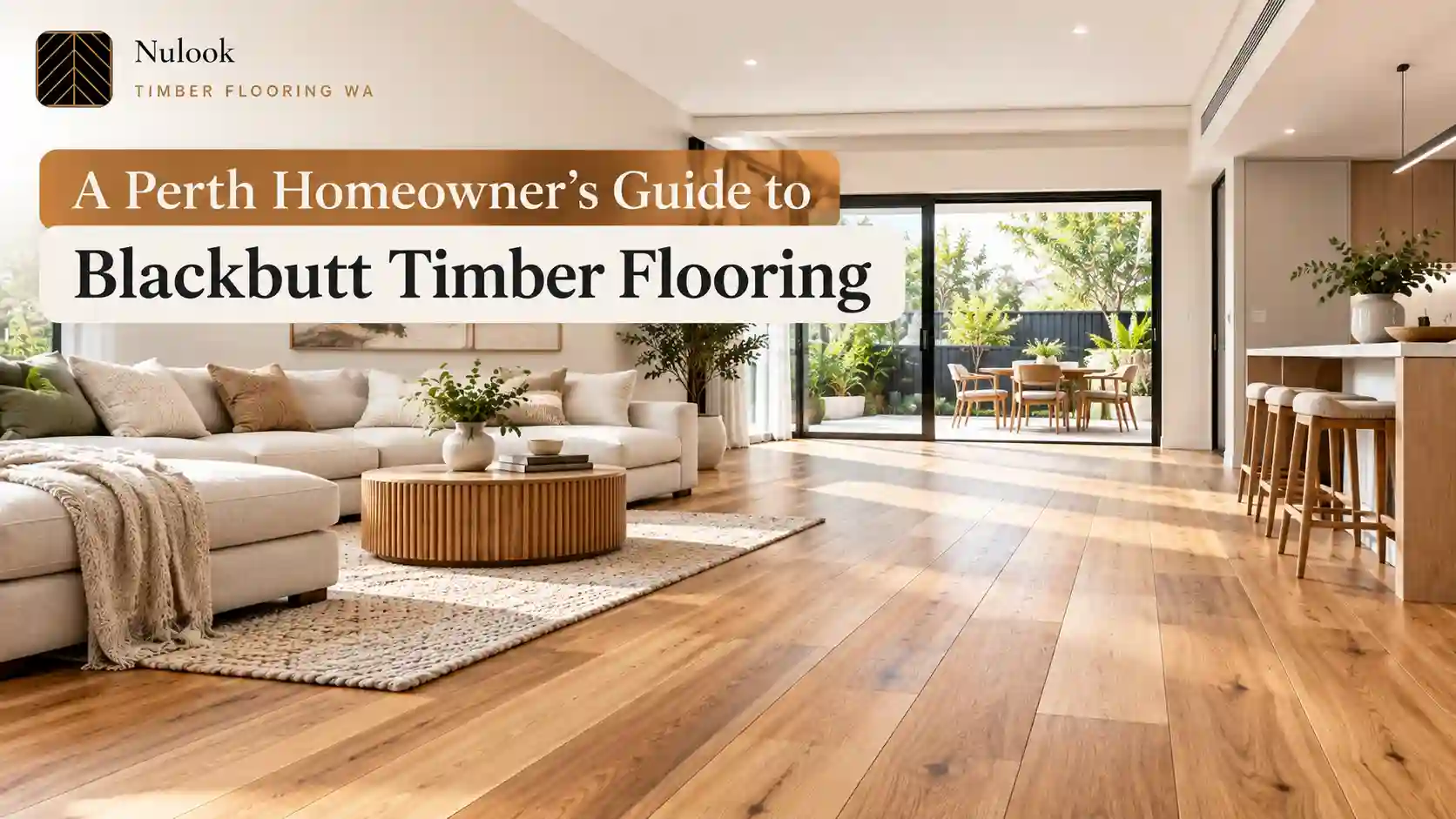
A Perth Homeowner's Guide to Blackbutt Timber Flooring
Quick answer: Blackbutt is one of Australia's most popular flooring timbers. It's a pale golden-to-light-brown native hardwood with a fairly even grain, a seasoned Janka hardness of about 8.9 kN, and a bushfire rating up to BAL-29. It suits most Perth homes, especially coastal and modern interiors. It's available as solid, engineered and (as a printed look) hybrid.
Blackbutt timber flooring shows up in a lot of the Perth homes we walk into. There's a good reason. It sits in a sweet spot: light enough to keep a room bright, hard enough for family life, and plain enough in grain that it doesn't fight with the rest of your interior.
But "Blackbutt" gets used loosely. Some products labelled Blackbutt are solid hardwood. Some are a Blackbutt veneer on a ply core. And a lot of what's sold as "Blackbutt hybrid" has no timber in it at all. This guide explains the difference, so you know what you're paying for.
What Is Blackbutt Timber?
Blackbutt (Eucalyptus pilularis) is a eucalypt that grows along the coast of New South Wales and southern Queensland, roughly from Bega up to Maryborough. The name comes from the bark near the base of the trunk, which gets blackened by bushfire. The timber inside is nothing like that.
According to WoodSolutions' Blackbutt species data, the heartwood runs from golden yellow to pale brown, now and then with a slight pinkish tone. The grain is mostly straight with an even texture. You'll see small gum veins and the odd pinhole in feature grades, which a lot of people like.
It isn't a West Australian species. Our local hardwood is Jarrah, which is much darker. Blackbutt is shipped across, but it's so widely milled that supply is steady and prices stay competitive with local timbers.
Why Is Blackbutt So Popular?
Two reasons, mostly.
First, colour. Blackbutt is one of the lightest Australian hardwoods that's still properly hard. It fits the coastal, Scandi and Japandi styles that have been popular in Perth for the past decade, and it doesn't turn a room orange the way some older polished floors do.
Second, it's forgiving. The even grain hides dust and small marks better than dark floors, which show every paw print and speck of sand. If you live anywhere between Scarborough and Mandurah, you'll know how much sand comes through the door in summer.
How Hard Is Blackbutt? (And Does It Matter?)
Hardness is measured with the Janka test: how much force it takes to push a small steel ball halfway into the timber. The higher the number, the better the timber resists dents from dropped objects and heels.
| Species | Seasoned Janka hardness | Seasoned density | Colour |
|---|---|---|---|
| Blackbutt | 8.9 kN | 900 kg/m³ | Golden yellow to pale brown |
| Jarrah | 8.5 kN | 820 kg/m³ | Deep brown to burgundy |
| Spotted Gum | 10.1 kN | 990 kg/m³ | Light brown to deep red-brown |
| American Oak (for comparison) | around 6 kN | around 750 kg/m³ | Light tan |
Figures for Australian species are from WoodSolutions (Blackbutt, Jarrah, Spotted Gum).
So Blackbutt is slightly harder than Jarrah and a bit softer than Spotted Gum. In practice, all three are hard enough for a busy family home. The ATFA's timber flooring hardness sheet makes a point we agree with: the coating and how you look after the floor matter as much as the species. A stiletto heel will mark any timber floor. A 30 kg dog with untrimmed nails will scratch the coating on any of them.
Is Blackbutt Good for High-Traffic Homes?
Yes. Blackbutt holds up well in hallways, family rooms and open-plan kitchens. Being lighter in colour, it also hides the fine scratches that come with daily life better than a dark stain would.
A few habits make a big difference:
- Felt pads under every chair and table leg
- A good mat at each outside door to catch sand and grit
- Keep pet nails trimmed
- Clean with a microfibre mop and a pH-neutral timber cleaner, never a steam mop
We go through aftercare at handover on every job. The biggest enemy of a Blackbutt floor in Perth isn't the kids. It's beach sand acting like sandpaper under shoes.
Blackbutt and Perth's Climate
Timber takes up moisture from the air and gives it back again. The ATFA explains this in their note on acclimatisation of timber flooring: boards are now made to about 10–11% moisture content, which suits most Australian homes without long acclimatisation.
Perth's challenge is the swing between seasons. Long dry summers pull moisture out of timber, and you may see fine gaps open between solid boards around February and March. They usually close again in winter. That's normal timber movement, not a defect, and a good installer leaves the right expansion gaps around the edges to allow for it.
If gaps bother you, engineered Blackbutt is the answer. The cross-laid core keeps it far more stable through the seasons.
Blackbutt also carries a bushfire rating suitable for BAL-12.5, BAL-19 and BAL-29 under AS 3959. That matters if you're building in the Perth Hills or on the semi-rural fringe, where the bushfire assessment on your block may limit which materials you can use.
Solid vs Engineered vs Hybrid "Blackbutt"
This is where people get caught out.
Solid Blackbutt
Solid boards are milled from one piece of hardwood, usually 14–19 mm thick. Pre-finished solid boards come from the factory already coated, so there's no sanding or polishing on site and you can walk on them the same day. They can be sanded many times over their life. This is our premium line, and our solid timber flooring page explains how we lay it.
Engineered Blackbutt
A real Blackbutt top layer, usually 3–6 mm, on a multi-ply core. It looks identical to solid once it's down, it's more stable in Perth's dry summers, and it glues straight to a concrete slab. For most Perth homes on slabs, engineered Blackbutt is what we recommend. See our engineered timber flooring page for the range.
Blackbutt hybrid
About 480 Australians a month search for "Blackbutt hybrid flooring". Here's what they're getting: a photograph of Blackbutt grain printed onto a stone-plastic core. There's no Blackbutt in it. It can look very good and it's waterproof, but you can't sand it and it won't age like real timber. If you're weighing that up, read our engineered vs hybrid flooring comparison.
Blackbutt Grades: Select, Standard and Feature
Australian hardwood flooring is sold in grades that describe how many natural features the boards show. The ATFA's hardwood flooring grades sheet has the full definitions, but in short:
- Select is the cleanest look, with very few gum veins or knots. It costs the most.
- Standard allows some gum veins and small features. It's a good middle ground.
- Feature (sometimes called "character") has plenty of gum veins, pinholes and colour variation. It's usually the cheapest, and to our eye often the most interesting.
Ask to see a full box, not a single sample board. One board can't show you the range of colour you'll get across a whole room.
Which Finish Suits Blackbutt?
With pre-finished boards, the coating is applied at the factory, usually a UV-cured polyurethane or oil. With raw boards sanded on site, you choose:
- Water-based polyurethane keeps Blackbutt pale and natural. This is the most popular choice for a modern look.
- Oil-modified or solvent-based coatings give it a warmer, honey tone that deepens over time. The ATFA notes that solvent coatings and oils darken as they age, while water-based finishes stay closer to the original colour.
Sheen is the other choice. Matte and satin hide scratches far better than gloss. We rarely recommend gloss for a family home.
Spotted Gum vs Blackbutt
The two get compared constantly (320 searches a month in Australia for "spotted gum vs blackbutt"). Spotted Gum is harder and has much more colour movement, from creamy browns to deep reds, and a wavy, rippled grain. Blackbutt is calmer and more even.
Pick Spotted Gum if you want a floor with a lot of character and warmth. Pick Blackbutt if you want the floor to sit in the background and let the furniture and art do the talking.
Laying Blackbutt on a Perth Concrete Slab
Most Perth homes are double brick on a concrete slab, so this is the question that decides which Blackbutt you can have.
Engineered Blackbutt is the simplest. It's glued straight to the slab with a flexible flooring adhesive, and many of these adhesives also act as a moisture barrier. Before that, the slab needs to be flat, clean and dry. We grind off high spots and old glue, fill low spots with a self-levelling compound, and test moisture levels. Skip any of those steps and you risk hollow-sounding boards or, worse, boards lifting months later.
Solid Blackbutt can also go on a slab, either glued direct or fixed to a plywood layer that's been glued and fixed to the concrete. The plywood method adds height and cost, but it gives a slightly softer feel underfoot. It's often chosen when the floor needs to line up with an existing timber floor next to it.
Our guide to installing timber flooring over concrete covers moisture testing and levelling in more detail.
Matching Stairs, Skirting and Trims
One advantage of real Blackbutt: every part of the job can match. Stair treads, nosings and landings can be made from the same species and coated to the same finish, so the floor carries straight up the stairs without a colour break. Our timber staircases are cut and finished to match the floor boards.
Skirting is worth thinking about too. White painted skirting gives a clean, modern edge against pale Blackbutt. Timber skirting in the same species looks warmer and a bit more traditional. Both work, so pick the one that suits the rest of your trims and door frames.
How Much Does Blackbutt Flooring Cost in Perth?
It depends on the format and grade. As a rough guide for supply and install in Perth in 2026:
- Engineered Blackbutt: about $150–$215 per m²
- Solid pre-finished Blackbutt: about $170–$295 per m²
- Blackbutt-look hybrid: about $60–$125 per m²
Feature grade sits at the lower end, select at the top. Board width matters as well: wide boards (180 mm and up) use more premium timber and usually cost more per m² than standard 130 mm boards. Subfloor prep, old floor removal, skirting and stairs are extra. Our Perth timber flooring cost guide breaks all of that down.
See Blackbutt in Your Own Light
Blackbutt looks different next to white walls than it does next to timber cabinetry, and different again under Perth's strong afternoon sun. Nulook Timber Flooring brings solid and engineered Blackbutt samples to a free on-site measure, checks your subfloor for moisture, and gives you a fixed written quote. Have a look at our project gallery, then request your free quote or call 0405 821 884.
Frequently Asked Questions
Is Blackbutt good for flooring?
Yes. Blackbutt is a hard, stable Australian hardwood with a light, even colour. It suits most homes, handles family traffic well and can be sanded back many times as a solid board, so it lasts for decades.
How hard is Blackbutt timber?
Seasoned Blackbutt has a Janka hardness of about 8.9 kN and a density of around 900 kg/m³. That's slightly harder than Jarrah (8.5 kN) and a little softer than Spotted Gum (10.1 kN).
Does Blackbutt flooring scratch easily?
Like all timber, Blackbutt can scratch, mostly in the coating rather than the timber itself. Its light colour hides fine marks well. Felt pads, doormats and trimmed pet nails prevent most damage.
What colour is Blackbutt timber?
Blackbutt ranges from golden yellow to pale brown, now and then with a slight pink tone. Under UV light and some coatings it warms slightly over time. Water-based finishes keep it closest to its natural pale colour.
Is Blackbutt good for dogs?
Blackbutt is a reasonable choice with dogs because it's hard and its pale colour hides fine scratches. For large, active dogs, a matte finish and regular nail trimming help. Hybrid is more scratch-resistant but isn't real timber.
What's the difference between Blackbutt hybrid and Blackbutt timber?
Blackbutt timber, solid or engineered, is real hardwood. Blackbutt hybrid is a printed image of Blackbutt grain on a stone-plastic core. Hybrid is waterproof and cheaper, but it can't be sanded and won't age like real timber.
Is engineered Blackbutt as good as solid?
For most Perth homes on concrete slabs, yes. Engineered Blackbutt has a real Blackbutt top layer, looks the same once laid, and is more stable through seasonal humidity changes. Solid Blackbutt can be sanded more times over its life.
How much does Blackbutt flooring cost per square metre in Perth?
In 2026, installed engineered Blackbutt typically costs about $150 to $215 per square metre in Perth, and solid pre-finished Blackbutt about $170 to $295. Subfloor preparation, removal and skirting are usually extra.
Is Blackbutt suitable for bushfire-prone areas?
Blackbutt is rated for BAL-12.5, BAL-19 and BAL-29 applications under Australian Standard AS 3959, which makes it one of the more suitable hardwoods for homes in bushfire-prone areas such as the Perth Hills.
Spotted Gum or Blackbutt: which is better?
Neither is better overall. Spotted Gum is harder and has bold colour variation and wavy grain. Blackbutt is lighter and more even. Choose Spotted Gum for character and Blackbutt for a calm, bright, modern look.