Spotted Gum Flooring: Perth
Spotted gum flooring explained: colour, hardness, grades, solid vs engineered, spotted gum vs blackbutt, and Perth installed prices for 2026.
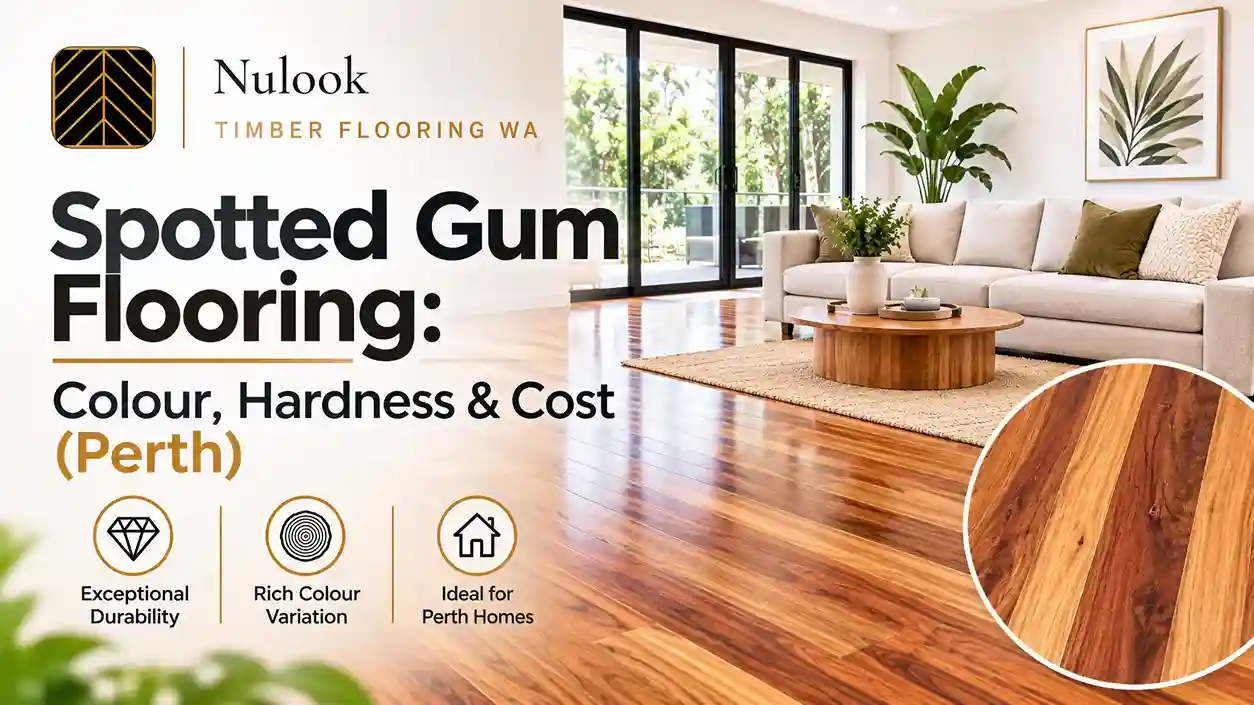
Spotted Gum Flooring: Colour, Hardness, Cost and Is It Right for You?
Quick answer: Spotted gum is one of the hardest Australian hardwoods used for flooring, with a seasoned Janka rating of about 10.1 kN and a colour range from light brown to deep red-brown. It's termite resistant and suits busy homes. In Perth, engineered spotted gum typically costs $150–$215 per m² supplied and installed, and solid boards about $170–$295 per m².
Spotted gum is the floor people point at in display homes and say "that one". It's a lively floor. Pale creamy boards sit next to chocolate ones, and the grain ripples across the room. Some people love it straight away. Others find it too busy.
We're Nulook Timber Flooring WA, and we lay spotted gum in Perth homes. This guide covers what spotted gum looks like in a real home, how hard it is, the grades and formats, how it compares with blackbutt and jarrah, and what it costs to have laid in Perth in 2026.
Spotted Gum at a Glance
| Feature | Spotted gum |
|---|---|
| Botanical names | Corymbia maculata, C. citriodora and C. henryi |
| Where it grows | East coast, from far-east Victoria through NSW into Queensland |
| Colour | Light brown through to dark red-brown, with creamy sapwood in feature grades |
| Seasoned density | About 990 kg/m³ |
| Janka hardness (seasoned) | About 10.1 kN |
| Termites | Heartwood rated resistant |
| Bushfire | Suitable for BAL-12.5, BAL-19 and BAL-29 under AS 3959 |
| Installed price, Perth | Engineered about $150–$215 per m²; solid about $170–$295 per m² |
Hardness, density, termite and bushfire figures are from WoodSolutions' spotted gum species page. Prices are typical Perth supply-and-install ranges for 2026, before strip-out, slab prep, skirting and stairs.
What Does Spotted Gum Look Like?
Spotted gum gets its name from the bark, which sheds in patches and leaves the trunk spotted. The timber underneath isn't spotted. It's known for three things.
- Colour range. One pack of boards can run from pale grey-brown and honey through to deep red-brown and chocolate. That spread is what people love about it, and what puts some people off.
- Wavy grain. Many boards have a rippled "fiddleback" figure that catches the light as you walk past.
- Gum veins. Thin dark lines of natural gum show up in standard and feature grades. They're part of the character, not a defect.
The colour also changes with the coating. A water-based finish keeps spotted gum closest to its raw colour. Oil-modified and solvent finishes pull it warmer and more amber, and that tone deepens over the years. We cover finishes in our sanding and polishing guide.
Is it too busy for a modern home? It depends on the room. In a big open-plan space with plain walls and simple cabinetry, spotted gum looks warm and natural. In a small room full of patterned furniture, it can feel like a lot. If you want something calmer, look at a select grade or at blackbutt.
How Hard Is Spotted Gum?
At about 10.1 kN seasoned, spotted gum is harder than blackbutt (8.9 kN), karri (9.0 kN) and jarrah (8.5 kN). It's well ahead of European oak, which sits around 5 kN on The Wood Database figures.
In practice that means:
- Better dent resistance. Dropped toys, chair legs and heels leave fewer marks than on softer timbers.
- Good for dogs. Claws still scratch the coating, as they will on any floor, but spotted gum resists more knocks than most species. The colour variation hides fine scratches well.
- Harder to work. It's a dense timber, so cutting and machining are slower. That's one reason it costs a little more to lay than softer species.
Hardness isn't the whole story, though. The coating takes most of the daily wear. A hard floor with a worn finish will still look tired. Felt pads, a doormat at each entry and a recoat every few years matter as much as the species.
Grades: Select, Standard and Feature
Spotted gum is sorted into grades by how much natural character each board shows. Names vary a little between mills, but the idea is the same.
| Grade | What you see | Best for |
|---|---|---|
| Select (prime) | Fewest gum veins and knots, more even colour | Modern, minimal rooms |
| Standard (standard and better) | Some gum veins and colour variation | Most homes: the usual middle choice |
| Feature (character) | Plenty of gum veins, pinholes, sapwood and colour swings | Rustic or coastal looks, lower cost |
Feature grade is usually the cheapest, and select the dearest. Wider boards (180 mm and up) also cost more per m² than the common 130 mm width.
Always look at a large sample, not one board. A single feature-grade board looks wild. Twenty of them laid together read as texture.
Solid vs Engineered Spotted Gum
You can buy spotted gum as solid boards or as engineered boards with a spotted gum top layer.
Solid spotted gum is usually 14 to 19 mm thick, tongue-and-groove. It can be sanded and recoated many times over its life. On a Perth concrete slab it's direct-stuck with a flexible adhesive after the slab has been ground, moisture tested and levelled. Pre-finished solid boards arrive already coated, so there's no sanding on site and the floor can be walked on the same day.
Engineered spotted gum has a real spotted gum wear layer, usually 3 to 6 mm, on a plywood core. The cross-laid core makes it more stable through Perth's dry summers and humid winters. It's lighter to handle and usually a little cheaper. A 3 mm layer can typically be sanded once or twice, and a 4–6 mm layer a few more times.
"Spotted gum hybrid" and "spotted gum vinyl" are different products. They're a printed photo of spotted gum on a plastic or stone-plastic core. They're waterproof and cheaper, but there's no timber in them and they can't be sanded. Our engineered vs hybrid flooring guide explains the trade-offs.
For most Perth homes on a slab, we suggest engineered spotted gum. You get the real timber look and feel with better stability, and the price gap to hybrid is smaller than most people expect. Solid is the better pick if you want the floor to last 50 years or more and be sanded several times.
Spotted Gum vs Blackbutt vs Jarrah
These are three Australian hardwoods Perth homeowners often ask us about.
| Spotted gum | Blackbutt | Jarrah | |
|---|---|---|---|
| Janka (seasoned) | 10.1 kN | 8.9 kN | 8.5 kN |
| Density | 990 kg/m³ | 900 kg/m³ | 820 kg/m³ |
| Colour | Light brown to red-brown, lots of variation | Golden yellow to pale brown, even | Deep red to burgundy |
| Look | Busy, wavy grain | Calm, straight grain | Rich, traditional |
| Where it grows | NSW and QLD | NSW and QLD | South-west WA |
| Hides dust and scratches | Very well | Well | Shows dust more |
| Relative cost in Perth | Mid to high | Mid | High and rising |
Density and hardness figures are from WoodSolutions.
Spotted gum or blackbutt? Choose spotted gum if you want a harder floor with lots of character that hides daily wear. Choose blackbutt if you want a lighter, quieter floor that suits Scandi or coastal styles. Prices are close, with blackbutt often slightly cheaper. Our Blackbutt timber flooring guide covers that species in detail.
Spotted gum or jarrah? Jarrah is the WA classic, with a deep red that suits older Perth homes and character renovations. Spotted gum is harder, more varied and easier to source now that WA native forest logging has ended. Jarrah is also more expensive.
Spotted Gum and Perth Conditions
Spotted gum isn't a WA timber. It's grown and milled on the east coast and shipped west, which adds a little to the price and lead time. It still performs well here.
- Dry summers. Solid boards shrink a little in the dry months, so fine gaps can open between boards around February and March, then close again in winter. Engineered boards move less.
- Sun. Perth sun is strong. Every timber changes colour under UV, and spotted gum mellows and warms over time. Blinds, UV-rated glass and moving rugs now and then keep the colour even.
- Slabs. Most Perth homes are on concrete. The slab has to be flat and dry before anything is glued down. We explain the steps in laying timber flooring over concrete.
- Bushfire zones. WoodSolutions lists spotted gum for BAL-12.5, BAL-19 and BAL-29 applications, which matters for homes in the Perth Hills and on the urban fringe.
How Much Does Spotted Gum Flooring Cost in Perth?
| Product | Typical Perth price (supplied and installed, 2026) |
|---|---|
| Engineered spotted gum | About $150–$215 per m² |
| Solid pre-finished spotted gum | About $170–$295 per m² |
| Spotted gum-look hybrid (not timber) | About $58–$125 per m² |
Supply-only prices for solid spotted gum on Australian retail sites start at about $55 per m² for narrow feature-grade boards and reach about $125 or more for wider standard-grade boards. Adhesive, labour and prep come on top.
Where your job lands depends on the grade, board width, whether boards are solid or engineered, and the slab. Common extras are carpet or tile removal, grinding and levelling, skirting and stairs. Our timber flooring cost guide breaks these down.
Worked example: a 50 m² open-plan living area in Joondalup, carpet to engineered spotted gum, standard grade, 180 mm wide boards, glued to the slab.
| Item | Estimate |
|---|---|
| Carpet removal (50 m² × $10–$15) | $500–$750 |
| Engineered spotted gum, supplied and laid (50 m² × $170–$215) | $8,500–$10,750 |
| Spot levelling where needed | $400–$1,200 |
| Skirting (32 lm × $12–$32) | $380–$1,020 |
| Total | about $9,800–$13,700 |
Caring for a Spotted Gum Floor
Spotted gum is low-maintenance, but the finish still needs looking after.
- Weekly: vacuum with a soft-floor head or sweep, then damp mop with a pH-neutral timber floor cleaner. Avoid steam mops, vinegar and bleach.
- Every day: put doormats at each entry. Perth beach and garden sand is the biggest cause of dull, scratched coatings.
- Furniture: fit felt pads to chair and table legs and lift heavy items rather than dragging them.
- Every 5–10 years: a screen and recoat refreshes the finish before it wears through to bare timber.
- Every 10–15 years: a full sand and recoat on solid boards, or on engineered boards with a thick enough wear layer.
Standard-grade spotted gum with a matte or satin finish is one of the most forgiving floors to live with. Small marks blend into the natural colour variation instead of standing out.
Is Spotted Gum Flooring Right for You?
Spotted gum is a strong choice if:
- You have kids, dogs or a busy household and want a hard floor that hides wear
- You like natural variation and a floor with some personality
- You're in a bushfire-prone area and need a BAL-rated species
- You want a timber that will last decades and can be refinished
It may not suit you if:
- You want a calm, even, very light floor (look at blackbutt or a light European oak)
- Your room is small and already busy with pattern
- Your budget is under about $100 per m² installed (hybrid is the realistic option there)
Getting Spotted Gum Laid by Nulook Timber Flooring WA
Nulook Timber Flooring WA supplies and installs solid and engineered spotted gum across Perth, from strip-out and slab prep to skirting and stairs, with one crew. We'll bring large samples in two or three grades so you can see them in your own light, then give you a fixed quote.
See our solid timber flooring and engineered timber flooring services, or book a free measure and quote.
Frequently Asked Questions
Is spotted gum good for flooring?
Yes. Spotted gum is one of the hardest Australian flooring timbers, at about 10.1 kN on the Janka scale. It's termite resistant, hides scratches well thanks to its colour variation, and suits busy homes with kids and pets.
What are the disadvantages of spotted gum flooring?
The strong colour variation can feel busy in small or heavily decorated rooms. It's dense, so it costs a little more to machine and install, and it's grown on the east coast, so Perth prices include freight. Solid boards can also show small seasonal gaps in dry summers.
Is spotted gum flooring expensive?
It's mid to high priced. In Perth, engineered spotted gum typically costs $150 to $215 per square metre supplied and installed, and solid boards about $170 to $295. Feature grade is cheaper than select, and narrower boards cost less than wide ones.
Is blackbutt or spotted gum better?
Neither is better overall. Spotted gum is harder (10.1 kN vs 8.9 kN) and hides wear better. Blackbutt is lighter, calmer and often slightly cheaper. Choose on the look you want and how busy your household is.
What is cheaper, blackbutt or spotted gum?
Blackbutt is usually slightly cheaper, but the gap is small and depends on grade and board width. A feature-grade spotted gum can cost less than a select-grade blackbutt.
Why is spotted gum so expensive?
It's a dense hardwood that's slower to mill, dry and machine, and supply of wide, select-grade boards is limited. In WA, freight from the east coast adds to the cost.
Can spotted gum flooring get wet?
Only briefly. Spills wiped up quickly won't harm a properly coated spotted gum floor. Standing water, wet mopping or a leaking dishwasher can cause swelling or cupping, as with any timber floor. Use a damp mop and a pH-neutral timber floor cleaner.
Can you make spotted gum flooring lighter?
Only partly. A water-based coating keeps it closest to its natural colour, while oil-modified finishes make it warmer and more amber. Bleaching or white-tinted coatings can lighten it, but the natural colour variation will still show through.
Is engineered spotted gum as good as solid?
For most Perth homes on a slab, yes. Engineered spotted gum has a real timber top layer of 3 to 6 mm, moves less with the seasons and costs a little less. Solid boards can be sanded more times, so they last longer over many decades.
How long does spotted gum flooring last?
A well-installed solid spotted gum floor can last 50 years or more, with sanding and recoating every 10 to 15 years. Engineered boards typically last 25 to 40 years or more, depending on the thickness of the wear layer.