Jarrah Flooring Perth: Cost & Restoration
Jarrah flooring in Perth: colour, hardness, solid vs engineered vs recycled, supply after the WA logging ban, 2026 prices and restoring old floors.
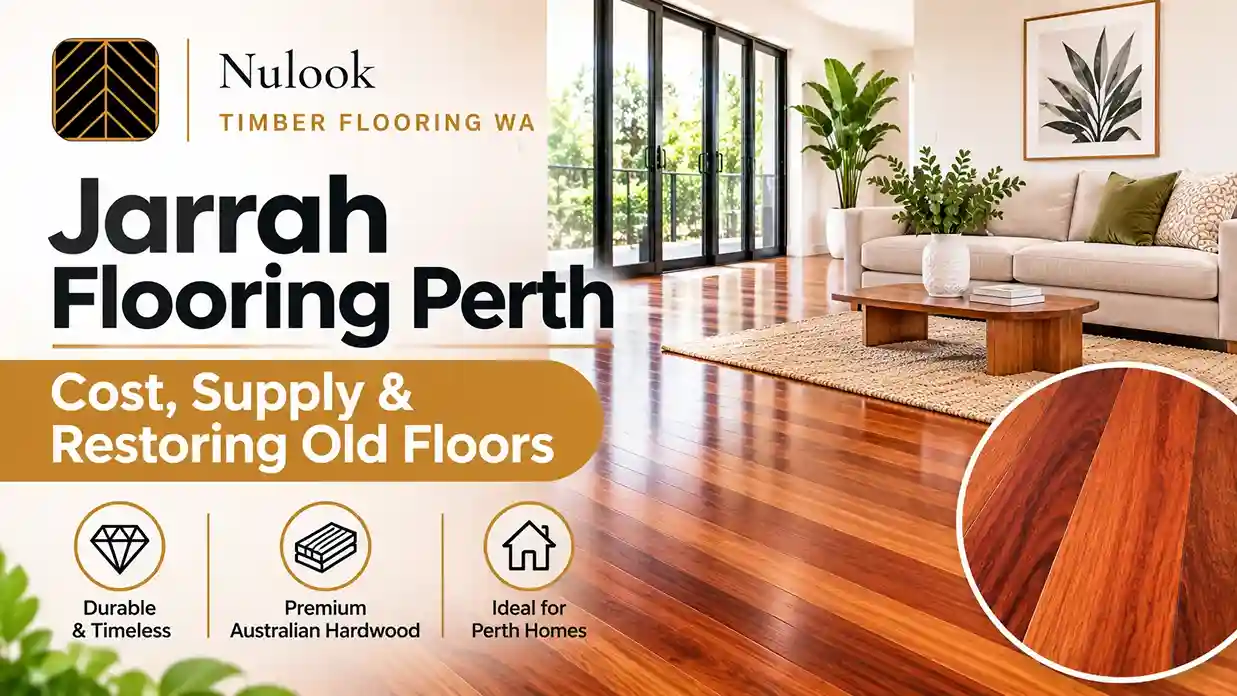
Jarrah Flooring: Why WA's Own Hardwood Still Makes a Great Floor
Quick answer: Jarrah is a Western Australian hardwood with a deep red-to-burgundy colour, a seasoned Janka hardness of about 8.5 kN and good termite resistance. New jarrah is now scarcer and dearer because commercial native forest logging in WA ended in 2024. In Perth, expect roughly $180–$250 per m² installed for engineered jarrah and $200–$320 for solid.
If you grew up in Perth, you've probably walked on jarrah. It's under the carpet in thousands of 1950s to 1970s homes, on verandahs, in old shopfronts and in heritage halls. That deep red colour is what many West Australians picture when they hear "timber floor".
Written by the team at Nulook Timber Flooring WA in Perth, this guide covers what jarrah is, how it compares with other hardwoods, where new jarrah comes from now, what it costs in 2026, and what to do if you've found old jarrah under your carpet.
Jarrah at a Glance
| Feature | Jarrah |
|---|---|
| Botanical name | Eucalyptus marginata |
| Where it grows | The south-west corner of Western Australia |
| Colour | Rich red to deep brown and burgundy, deepening with age |
| Seasoned density | About 820 kg/m³ |
| Janka hardness (seasoned) | About 8.5 kN |
| Termites | Heartwood rated resistant |
| Formats | Solid, engineered, recycled |
| Installed price, Perth (2026) | Engineered about $180–$250 per m²; solid about $200–$320 per m² |
Density, hardness and termite ratings are from WoodSolutions' jarrah species page. Prices are typical Perth ranges and vary with grade, board size and supply.
What Makes Jarrah Different
Jarrah grows only in the south-west of WA, on the ironstone and laterite country between Perth and Albany. It's been the state's signature building timber for over a century, used for floors, joinery, railway sleepers and even London's old wooden road blocks.
Three things set it apart as a floor.
- Colour. Few common flooring timbers have jarrah's red. New boards can look quite bright, then deepen into a softer burgundy over a few years.
- Character. Standard and feature grades show gum veins, pinholes and colour shifts. Older and recycled boards often have nail holes and a patina that new timber can't copy.
- A WA story. Plenty of Perth owners choose jarrah because it's local, matches the original floors in their home, or suits a heritage renovation.
How Hard Is Jarrah?
At about 8.5 kN, jarrah is a hard, durable floor, but it isn't the hardest. It's a little softer than blackbutt (8.9 kN), karri (9.0 kN) and spotted gum (10.1 kN), and much harder than European oak (around 5 kN).
| Species | Janka (seasoned) | Colour |
|---|---|---|
| Spotted gum | 10.1 kN | Light brown to red-brown |
| Karri | 9.0 kN | Pale pink to reddish brown |
| Blackbutt | 8.9 kN | Golden yellow to pale brown |
| Jarrah | 8.5 kN | Red to deep burgundy |
| Marri | 7.1 kN | Lighter, with heavy gum veins |
| European oak | About 5 kN | Light tan |
Hardness figures for the Australian species are from WoodSolutions. The European oak figure is from The Wood Database.
For a family home, jarrah handles daily life well. It will dent if you drop something heavy, and a dark red floor shows dust and pale pet hair more than a mid-tone floor does. A satin or matte finish hides marks better than gloss.
Where Does New Jarrah Come From Now?
This is the big change since most online jarrah guides were written. Under WA's Forest Management Plan 2024–2033, commercial logging in native forests ended on 1 January 2024. Native timber is now only available from ecological thinning, which is aimed at forest health.
For flooring buyers, that means:
- Less new jarrah, and smaller logs. Thinning produces smaller trees, so wide, long, select-grade boards are harder to get.
- Higher prices. Industry reports since the ban describe tight supply and rising hardwood prices. Expect jarrah to stay at the top end of Australian species.
- Longer lead times. Allow extra time to secure stock, especially for larger areas or matching an existing floor.
- More engineered and recycled jarrah. Engineered boards use far less jarrah per m², and recycled jarrah gives old timber a second life.
If jarrah is your first choice, talk to your installer early so they can confirm stock before you lock in dates.
Solid, Engineered or Recycled Jarrah?
| Format | What it is | Pros | Watch for |
|---|---|---|---|
| Solid jarrah | Tongue-and-groove boards, usually 14 to 19 mm | Can be sanded many times, lasts generations | Highest price, more seasonal movement |
| Engineered jarrah | A jarrah wear layer (often 3 mm) on a plywood core | More stable on slabs, uses less timber, usually cheaper | Fewer sands over its life |
| Recycled jarrah | Boards re-milled from old floors, beams and buildings | Unique patina and history, sustainable | Variable stock, nail holes, may need more prep and sanding |
For a Perth slab home, engineered jarrah is often the practical choice. It's glued straight to a prepared slab, moves less through dry summers and costs less than solid. Our floating vs glue-down vs nail-down guide explains the installation options.
For a heritage home on timber joists, solid jarrah is the natural match. It can be nailed to joists like the original floor and sanded on site to blend in.
Recycled jarrah suits people who want character above all else. Check the moisture content, the board profile and how much sorting the supplier has done before you buy.
Jarrah Grades and Board Sizes
Jarrah is graded by how much natural character each board shows. Mill names vary, but they fall into three groups.
| Grade | What you see | Look |
|---|---|---|
| Select (prime) | Very few gum veins or knots, even colour | Formal and refined |
| Standard (classic) | Some gum veins, pinholes and colour variation | The usual choice for homes |
| Feature (character) | Plenty of gum veins, pinholes and colour swings | Rustic and full of character |
Select-grade jarrah is the hardest to source since the logging ban, so it carries the biggest premium.
Common sizes include:
- Solid: 80 × 19 mm and 130 × 19 mm boards are the traditional sizes, matching many older Perth floors. Thinner 14 mm boards are common for direct-stick on slabs.
- Engineered: usually around 14 mm thick with a 3 mm jarrah layer, in widths of about 130–190 mm.
Narrow 80 mm boards give a classic, heritage look. Wider boards look more modern but cost more and need a very flat slab.
How Much Does Jarrah Flooring Cost in Perth?
| Product | Typical Perth price (supplied and installed, 2026) |
|---|---|
| Engineered jarrah, 14 mm with 3 mm wear layer | About $180–$250 per m² |
| Solid jarrah, pre-finished or sanded on site | About $200–$320 per m² |
| Recycled jarrah | Varies widely; often similar to or above solid |
| Sanding and polishing existing jarrah | About $32–$74 per m², typically around $47 |
Supply-only engineered jarrah from Perth suppliers sits around $129 per m² for a 136 mm board. Solid jarrah is usually priced per lineal metre, so convert it to m² before you compare quotes. Labour, adhesive and slab prep come on top.
Jarrah prices are moving with supply, so treat these as a guide and get a current quote. Our timber flooring cost guide lists the extras, such as removal, levelling, skirting and stairs.
Found Jarrah Under Your Carpet?
This is one of the most common Perth flooring questions. If your home was built before about 1980, there's a fair chance the carpet is sitting on jarrah boards over timber joists.
Here's how to check and what to do next:
- Lift a corner of carpet inside a wardrobe or behind a door. Look for tongue-and-groove boards, often around 80 mm wide (sometimes wider).
- Look for damage. Staple holes, tack strip, paint splashes and grey, worn patches are normal and usually sand out. Rot, borer damage or soft boards near wet areas need repairs.
- Check the thickness. Old solid jarrah floors often have plenty of timber left after 50 years and can take a full sand.
- Sand and recoat. A full sand and three coats typically costs $32–$74 per m² in Perth and takes three to five days for a typical home. Our floor sanding and polishing guide covers coatings and timelines.
Restoring old jarrah is usually far cheaper than laying a new floor, and you keep the original timber. If some boards are beyond saving, recycled jarrah can be used to patch them.
Jarrah Colour, Finishes and Styling
Jarrah's colour is part of the decision, so here's what to expect.
- Water-based coatings keep jarrah closest to its natural red with little yellowing.
- Oil-modified and solvent coatings push it warmer and darker, with more amber over time. They suit a traditional look.
- Can you lighten jarrah? Only partly. Bleaching and white-tinted coatings can tone it down, but jarrah will never look like blackbutt or pale oak. If you want a light floor, choose a lighter species.
- Painting jarrah is possible but hard to undo, and it hides the timber you paid for.
For styling, jarrah works with warm whites, soft greys, olive and sage greens, and natural stone with cream or warm grey tones. It can clash with cool, blue-based greys and with other red or orange timbers. Our timber flooring vs tiles guide also covers mixing timber with tiled areas.
Karri and Marri: The Other WA Hardwoods
If you want a West Australian timber but jarrah is hard to get or over budget, ask about two other south-west species.
- Karri (about 9.0 kN, 900 kg/m³) is slightly harder than jarrah, with pale pink to reddish-brown tones. WoodSolutions rates it as not termite resistant, so it suits upper floors and well-protected homes. See WoodSolutions' karri page.
- Marri (about 7.1 kN) is softer and lighter, with dramatic gum veins. It suits rustic, character floors.
Both are affected by the same supply limits as jarrah, so check stock early.
Caring for Jarrah Floors
A well-finished jarrah floor is easy to live with. Vacuum or sweep regularly, damp mop with a pH-neutral timber cleaner, and never wet mop or use a steam mop. Put mats at every entry to stop sand scratching the coating, and felt pads under furniture.
Jarrah darkens in sunlight, so rugs left in one place for years will leave paler patches. Moving them now and then, and using blinds in north and west-facing rooms, keeps the colour even. Plan on a recoat every 5 to 10 years in busy areas, and a full sand when the coating has worn through.
Is Jarrah Right for You?
Jarrah is a great choice if:
- You love the red tones and want a floor with a WA story
- You're restoring or extending an older Perth home with original jarrah
- You want a hard, durable timber that can be sanded for decades
Look at other species if:
- You want a light or neutral floor (consider blackbutt or European oak)
- You need the hardest possible floor for heavy wear (consider spotted gum)
- Your budget is tight or your timeline is short, given current supply
Jarrah Flooring with Nulook Timber Flooring WA
Nulook Timber Flooring WA installs solid and engineered jarrah across Perth, including on concrete slabs. We handle strip-out, grinding, moisture testing, levelling, laying, skirting and stairs with one crew. We'll check stock and lead times before we quote, so your dates are realistic.
See our solid timber flooring service, or book a free measure and quote.
Frequently Asked Questions
Is jarrah flooring good?
Yes. Jarrah is a hard, durable WA hardwood with a seasoned Janka rating of about 8.5 kN and termite-resistant heartwood. A solid jarrah floor can last for generations and be sanded many times. Its deep red colour is the main reason people choose it, or choose something else.
How much does jarrah flooring cost in Perth?
In 2026, engineered jarrah typically costs about $180 to $250 per square metre supplied and installed in Perth, and solid jarrah about $200 to $320. Prices are rising because new supply is limited, so always get a current quote.
Is jarrah an expensive wood?
Yes, it sits at the top end of Australian flooring timbers. Commercial native forest logging in WA ended on 1 January 2024, so new jarrah now comes only from limited thinning, which has tightened supply and pushed prices up.
Can you still buy new jarrah flooring?
Yes, but in smaller volumes. Some new jarrah comes from ecological thinning, and engineered and recycled jarrah are more readily available than new solid boards. Wide, long, select-grade boards are the hardest to source.
How do you restore old jarrah floorboards?
Remove the carpet, staples and tack strip, fix or replace damaged boards, then sand back to bare timber and apply three coats of finish. In Perth this typically costs $32 to $74 per square metre and takes three to five days for a typical home.
Can you lighten jarrah floorboards?
Only to a point. Bleaching or a white-tinted coating can soften the red, and a water-based coating avoids extra yellowing. Jarrah will never look as pale as blackbutt or light oak.
Is jarrah harder than oak?
Yes. Jarrah's seasoned Janka hardness is about 8.5 kN, while European oak sits around 5 kN and American white oak around 6 kN. Jarrah is more resistant to dents than either oak.
Can jarrah flooring be laid on a concrete slab?
Yes. Engineered jarrah and solid jarrah can both be direct-stuck to a concrete slab with a flexible adhesive, once the slab has been ground, moisture tested and levelled. Engineered boards are more stable on slabs.
What is recycled jarrah flooring?
It's jarrah re-milled from old floors, beams and buildings. It has a natural patina, nail holes and colour that new timber can't match. Supply varies, so quality and sorting differ between suppliers.
What colours go with jarrah floors?
Warm whites, soft warm greys, olive or sage greens and natural stone in cream or warm grey all work well with jarrah. Avoid cool, blue-based greys and other strong red or orange timbers next to it.